
Introducing…. The Purple Helmets
The Purple Helmets’ story is one of friendship, growth, and a whole lot of passion for music. Hailing from the small fishing town of Yarmouth, Nova Scotia, the bandmates were friends first, musicians second—learning their instruments along the way. In this chat, they talk about their guitar-driven sound, the importance of melody, and their love for 80s singles and UK indie. They share how their songwriting comes together, the energy they bring to live shows, and the surreal experience of recording with Paul Saurez in Grand Cayman. With new music on the horizon and some exciting label talks underway, they’re ready for the next chapter.
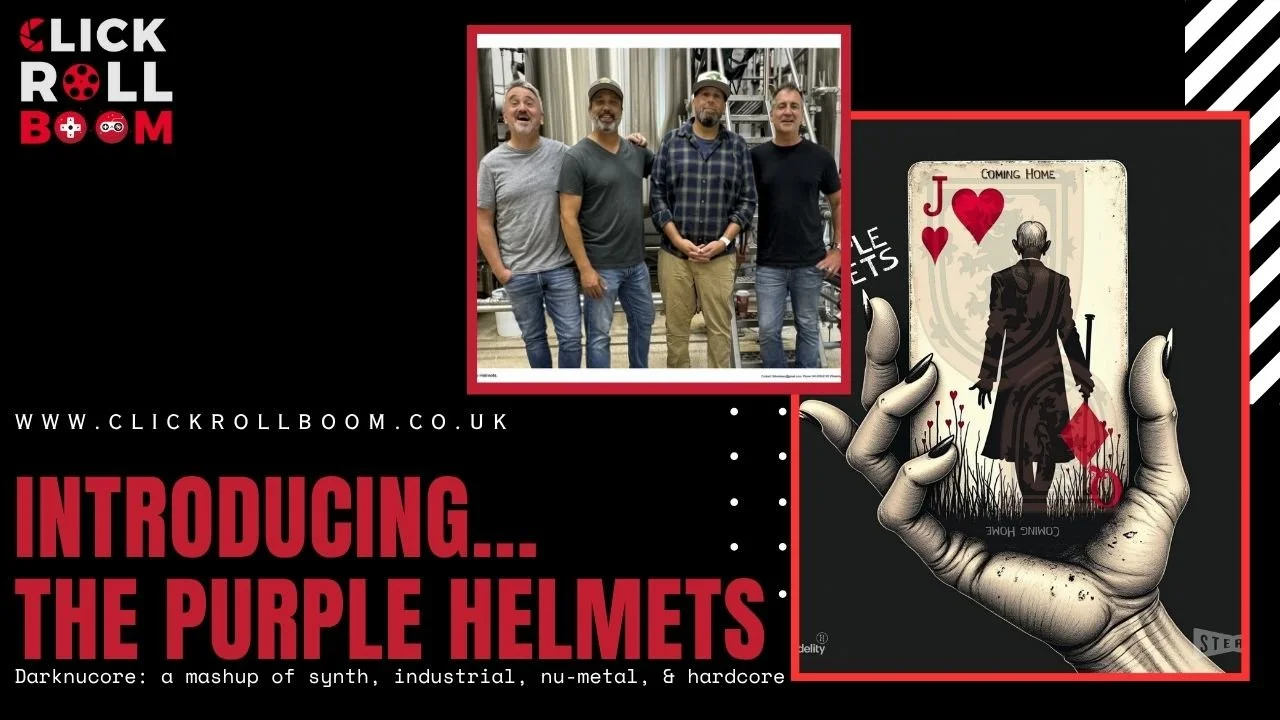
Click Roll Boom: Tell me about how you got started
The Purple Helmets: We all grew up in a small fishing community in Nova Scotia called Yarmouth. It’s a small town and we all knew each other as kids. Chris and Mike were neighbours and had started a metal band. Donnie had been playing in various bands around town and started jamming with Chris and Mike. Eventually, Jonathan was added as a singer and vocalist. Overtime we eventually moved to Halifax to play in larger venues and began writing and recording our own music. We released some independent music ourselves and eventually signed a deal with EMI, and toured Canada. In short, we were all friends first, then started a band, then learned how to play our instruments and works together as a group. We were just kids but became more proficient as musicians and songwriters as we got older.
CRB: How would you describe your sound, and how has it evolved since you first started?
TPH: The backbone of our sound is guitar based but the vocal melodies and harmonies are the centerpiece. I don’t think we have deviated from that formula over the years, but we have evolved in our songwriting and improved upon our sound overall. The only real difference is a little more use of synth on our latest album, Weirdo Squad. Its something we added for this album to create a little more atmosphere, but it’s not overdone or overly highlighted in the songs.
CRB: Who or what have been some of your biggest influences, musically and beyond?
TPH: We’ve always really enjoyed the 80s single era. Bands like Tears for Fears, Duran Duran, Bowie, REM, and the Outfield were always influential, especially in the way they sang melodies and created unforgettable ear worms. Living in Nova Scotia Canada puts us close to the United States and as a result, we also enjoy Americana, indie rock, and other genres from the US. We are also massively influenced by UK Indie and UK Brit pop. In our songwriting style, we just love to strip down a song to its essence and focus on melody and its memorable components. Our goal is to simply create an attractive indie tune that stands the test of time. Some listeners have referred to our sound as Americana Big Star meets UK Badfinger. A good song never goes out of style. To us it’s just “Canadiana.”
CRB: What does your songwriting process typically look like – is it a more individual or collaborative effort?
TPH: Our songwriting process is a mix of individual inspiration and collaborative refinement. Most songs begin in isolation—each of us tends to write in our own corner, developing ideas independently before bringing them to the group. Often, the writer will have the song nearly mapped out, with parts and structure already in place. From there, the rest of the band adds their own flavor—whether it’s through instrumental touches, vocal harmonies, or subtle arrangement tweaks. Other times, someone brings in just the bones of a song—chords, lyrics, maybe a rough melody—and we build it together from the ground up. That kind of collaboration can be really rewarding, allowing each of us to contribute creatively and shape the song as a collective. Both approaches work well for us. When a song is more fully formed, it can be a challenge to communicate the original vision clearly. But when we build something together from scratch, there’s often more room for everyone to leave their mark. Either way, the goal is the same: to serve the song and make it the best it can be.
CRB: How do you approach experimenting with new sounds or ideas when creating music?
TPH: A lot of our experimentation happens during the demo phase. We’ll try a song with a different feel or arrangement, and see what resonates. Sometimes the most unexpected idea ends up being the one that defines the track. Ultimately, we approach experimentation with an open mind. If it serves the song and feels authentic, we’re willing to try it.
CRB: What’s been one of the most memorable moments in your journey so far?
TPH: We certainly had many great moments when we were younger. It was such a great experience being part of the music scene in Halifax in the 90s. It was a very active scene and there was a lot of camaraderie with other bands and musicians. There were also so many opportunities to play live back then, which we really love to do. But fast forward to today, I have to say the making of our latest album is definitely one of the most memorable. Recording in Grand Cayman with Paul Saurez was an incredible experience. Paul has worked with Andy Wallace recording bands like Nirvana, Rage Against the Machine, The Cult, Guns and Roses; the list goes on and on. Having that calibre of talent working with you is a very special gift.
CRB: How do you prepare for live shows, and what do you aim to bring to your performances?
TPH: To be honest we really don’t perform live as much as we used to. Currently we are geographically dispersed with Chris in the Cayman Islands, Donnie in Ontario and Mike and John in Nova Scotia. We will fly to one spot, rehearse, and play live for a date here and there, and when we do have a show to prepare for we normally get together for 3 or 4 days and rehearse 5-6 hours a day. We always pick up where we left off in terms of musicianship and syncing together musically so its never much of an effort. It’s fun and we love it. We’d certainly travel to the right show/bill or festival which might be attractive. When we do play live we bring a great raw energy. The sound is large especially when layered with 3 part harmony on top of our guitar laden approach.
CRB: How do you balance creative expression with staying connected to your audience?
TPH: At our core, we write music that feels honest and meaningful to us—songs that reflect our experiences, influences, and emotions. That authenticity is what fuels our creativity and keeps us inspired. At the same time, we’re aware that music is a shared experience. We pay close attention to how people respond to our songs—whether it’s through live shows, messages, or streaming feedback. If a certain melody, lyric, or vibe resonates with listeners, we take note. It doesn’t mean we chase trends or compromise our sound, but we do value that connection and let it inform how we evolve. We think the sweet spot is when a song feels personal to us but still speaks to something universal. That’s when the magic happens—when your own story becomes someone else’s soundtrack. So while we always lead with creativity, we never lose sight of the people on the other side of the speakers.
CRB: What do you hope listeners take away from your work?
TPH: We hope listeners walk away from our music feeling something real—whether it’s nostalgia, comfort, joy, or even a sense of being understood. Our goal has always been to create songs that resonate on a personal level, the kind you can return to over time and still find meaning in. If someone hears one of our tracks and it reminds them of a moment in their life, helps them through something, or just makes their day a little better—that’s everything to us. At the end of the day, we want our music to feel timeless. Something that doesn’t just follow trends, but instead becomes part of someone’s personal soundtrack. If we can create that kind of connection, then we’ve done our job.
CRB: What does the future hold for you – any plans or goals you’re excited about?
TPH: Yes! We’re talking to a couple of boutique indie labels and hope to sign with one shortly. As artists we could use support and help with PR and marketing and joining a catalogue of similar artists can only help at this stage. We continue to write songs and aim to record another record with Paul Suarez later this year for an early 2026 release. Ideally we’d like to repeat that model annually. We laughed out loud at a recent article that referred to us as the “Hook Kings of Canada”. That’s quite a moniker, but we’d also like to strive to live up to it.