
Nathalie Miller crafts a cinematic reflection of a woman’s life on ‘like you used to’
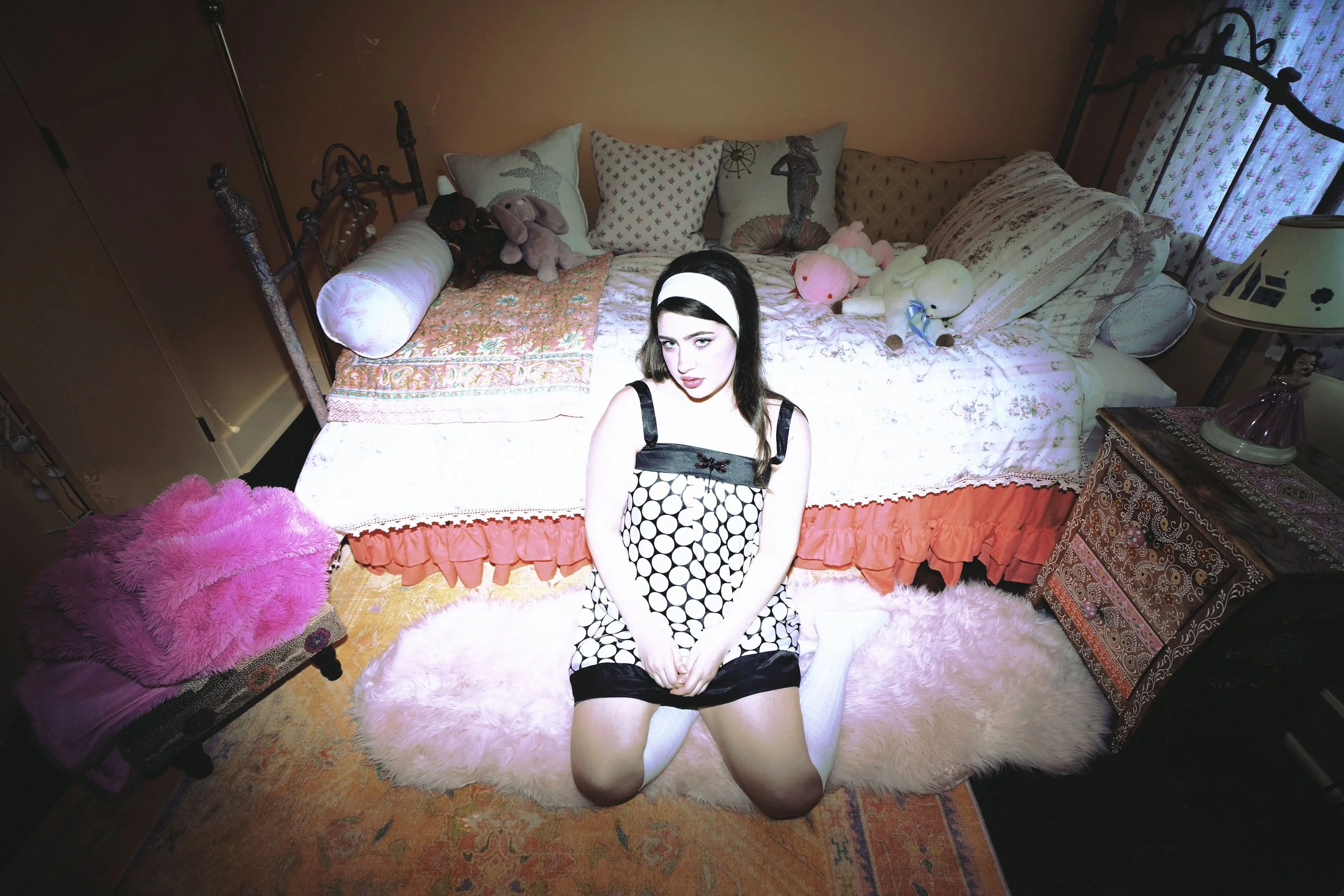
Brooklyn indie-pop artist finds her songwriting voice through a whimsical and ebullient sophomore EP out Friday, October 24
NOW PLAYING: Listen to ‘like you used to’ on all major platforms
September single ‘kansas’ is now playing on all platforms
Nathalie Miller on Spotify x Watch the ‘kansas’ video
New spotlight tracks ‘witches don’t burn’ and ‘sit and stew’ arrive with the EP
BROOKLYN, N.Y. [October 24, 2025] – There’s a famous quote from iconic 20th-century dancer, teacher, and choreographer Martha Graham, one can be lifted and applied to many various forms of expression and creativity, and it essentially states that a dancer dies twice — the first time coming when they stop dancing, and how that’s more painful than death itself. Its message speaks volumes about the difficulty in letting go of the things that define us as we live our lives, and who we become when that definition is no longer.
The sentiment snuck its way, admittedly paraphrased and re-worded, into a lyric from the title track of Nathalie Miller’s sophomore EP, a kaleidoscopic twirl of glittery and whimsical indie-pop titled like you used to, set for release on Friday, October 24.
The Brooklyn artist, who grew up dancing in her native Massachusetts before heading to New York City to study photography, had the lyric noted for potential use years before the song came together. And while it first caught her attention while she was busy exploring other creative avenues, it’s easy to replace the word “dancing” with “songwriting,” as Miller has found her calling.
“With anything else I’ve pursued, I’ve lost steam and regretted trying to make it into a living, but even on a day where I’m having a hard time writing or thinking I’m really bad at this, I still want to do it,” Miller admits. “Dance was physically dangerous for me with the conditions I have, and photography was more fun for me as a hobby than as a career. But music automatically writes itself in my head even when I’m actively trying not to.”
From Miller’s head, where the seeds of songs are first planted, to coming to fruition at Rare Signals in Cambridge, where she records with collaborator, producer, and multi-instrumentalist Brian Charles, the journey a thought or a feeling has towards eventually becoming a song is not always linear for the young musician.
Across like you used to, the dramatic and tumbling “witches don’t burn,” her take on the “manic pixie dream girl,” came to her in two fully-formed parts – the chorus and the bridge – both while she was in the shower. The lyrics in the chorus of glistening piano-led ballad “slippers” – jokingly inspired by when Miller used to tell her friends that guys in New York think being a bartender is the same thing as experiencing life as a woman – was assembled via word magnets often found on refrigerators. And she doesn’t even recall writing the towering indie anthem “sit and stew” – “which either means it was really easy,” she says, “or really difficult.”
The EP also features celestial lead single “kansas,” which dropped in September complete with a music video directed by Palmer Wells and Christopher Consoli, about the emotional labor women have to invest in their friendships with guys, dubbed a platonic friendship break-up song. And the aforementioned closing track, an ethereal lullaby daydream, pulls the listener deep into Miller’s playful world one last time, like a music box playing the comforting sounds that once helped us to sleep as a child.
Each song acts as a portal into the artist’s evolving world, where a portrait of life as a 20-something in an unhinged and chaotic time comes off with a sense of understanding and reassurance. And perhaps the strongest common thread between all the songs is her perspective as a woman. For Miller, this EP is an invitation; and songwriting helps her extend it in a way that feels concise and clear.
“I tend to over-explain everything,” she says with a laugh. “When I hang up the phone with someone, I immediately wanna call back and explain what I meant when I said ‘bye, talk soon’ – and music forces you not to do that. You can only explain so much in rhymes and classic song structure. I also feel like songwriting comes sort of naturally to me, like I never get sick of it.”
But even when Miller is being concise through song, her messaging has a cinematic quality to it. On “witches don’t burn” one of two new spotlight singles on the EP, Miller channels her New England roots as a defense mechanism for the way women are treated in society, and an almost punk cabaret, baroque-pop atmosphere around the song adds to the devilish tension.
“Coming from Massachusetts, I was thinking about the witch trials and how we still refer to the victims as ‘witches’, but they weren’t burning witches – they were burning women,” Miller reasons. “I tied that in with the purity culture we use to shame girls who we view as kinda wild and how we all partake in some kind of commentary about it, even if we think it’s positive. I had a friend once tell me I had a thing for befriending manic pixie dream girls, and that was also something I was thinking about, how that archetype of person pops up in my life repeatedly.”
The ebullient “sit and stew”, which perhaps steers closest to straight-up pop territory, swirls around the idea of lying as a form of protecting the ones we love. It also drew Miller back to her roots, but this time, in a far more personal way. The song’s upbeat demeanor belies its darker lyrical nature, and that’s truly by design.
“I was drawing from how my family tends to deal with tragedy, which is only talking about it if it comes up and never really initiating a news break,” she adds. “Anytime I find out someone in the family is sick or whatever, it’s through overhearing or someone assumes I already know, so they start talking about it casually. I feel like I accidentally adopted that trait where I’m not super great at talking about hard things without joking about it or lessening it somehow.”
Miller has been threading together bits and pieces of her personal life and filtering them into songs since her debut single “felt like” arrived a little more than two years ago. Coming from a musical family based just outside Boston, Miller relocated to New York City just before the pandemic to attend art school for photography and work as a model, and there she developed her own style and sound, reflecting on the past and looking back at her childhood from a distance.
Carving out her life in a new city and finding inspiration – musically, socially, and culturally -- all around her, she began penning lyrics and writing raw musical demos on her iPhone before taking them back up to Massachusetts to record with Charles.
At Rare Signals, Charles helps bring the songs Miller’s pictures so vividly in her head – literally seeing them in front of her — to sonic form, supplying traditional instrumentation like guitar, drums/drum programming, percussion, keyboards, and piano alongside more creative additions, like banjo (“kansas”, “sit and stew”, “like you used to”), mandolin (“slippers”), and Optigan (“like you used to).
“I like big songs,” Miller admits. “I like songs that feel like they’re going somewhere or building up to something, so I always try to go for a little of that. I also like making it sound like there are a lot of people on the record when it’s just Brian and me. It’s like a fun little secret. I always lean towards sounds that feel bittersweet and slightly nostalgic, but I wasn’t forcing any of the songs to sound like my previous stuff or like each other.”
Earlier this year she released her debut EP, made especially for you, led by the Fall 2024 single “mark like cain,” slowly cultivating and crafting a sound that blends indie-pop and alt-rock with poignant, confessional-style lyrics reminiscent of both classic singer-songwriters and modern pop vocalists.
And while she earned comparisons to the likes of Lucy Dacus, Chappell Roan, and Blondshell, part of the connective tissue relating to womanhood and simply “being a girl” that ties many of the EP songs together calls back to her own creative awakening when she was in high school.
“When I first started writing, I was listening to exclusively male artists,” she notes. “It would be really confusing because I would write these songs and I could hear them in my head, but they would sound so wrong to me when we tried to record them. It – thankfully – forced me to expand my taste and look into why I was only listening to men. The time I was in high school was kinda the time of tumblr where anything girly was flippant and vacant and indie bands with men were the most acceptable way to prove you were deep. I had to deconstruct all of that if I wanted to be a decent songwriter.”
Miller adds: “I also used to be scared of pop-leaning songs for that same reason of pop being seen as not art from its association with teen girls, but once I got over the internalized misogyny of that, I stopped policing the genre as much.”
And from there, she discovered her voice as a songwriter. It almost acts as an inverted version of the Graham quote, where instead of referencing the death of one’s creative output, the idea of embracing the day a person became what they truly were meant to be, could be seen as just as important as the day they were born.
‘like you used to’ EP artwork:

‘like you used to’ production credits:
All songs written and composed by Nathalie Miller
Recorded by Brian Charles at Rare Signals in Cambridge, MA
‘kansas’: Mixed, mastered, engineered, and produced by Brian Charles at Rare Signals, with additional engineering by Annie Hoffman. Guitar, banjo, drum programming, drums, and keyboards by Brian Charles.
‘witches don’t burn’: Mixed, mastered, engineered, produced by Brian Charles at Rare Signals, additional engineering by Annie Hoffman. Keyboards, piano, drums, bass, and guitar by Brian Charles.
‘sit and stew’: Mixed, mastered, engineered, produced by Brian Charles at Rare Signals, additional engineering by Annie Hoffman. Guitar, banjo, keyboards, piano, and bass by Brian Charles. Drums by Jamie Rowe.
‘slippers’: Mixed, mastered, engineered, and produced by Brian Charles at Rare Signals, additional engineering by Annie Hoffman. Piano, drum programming, guitar, mandolin, keyboards, and percussion by Brian Charles.
‘like you used to’: Mixed, mastered, engineered, and produced by Brian Charles at Rare Signals, additional engineering by Annie Hoffman. Optigan, synth, piano, percussion, guitar, and banjo by Brian Charles.
Cover art rendered by Max Miller
On new year's eve of 2020, independent artist Nathalie Miller called and booked her first ever studio session before hopping out of the car and running to her friends house to catch a midnight showing of Cats. This was her first step in inching towards releasing her music after working as a model and attending art school for photography in New York City. Three years later, she released her first single called “felt like”, a glittery indie-pop song, which she later followed with her debut EP made especially for you. Her sound blends indie-pop and alt-rock sounds with lyrics reminiscent of classic singer songwriters, all with a girlish sparkle. Stand out track and single “mark like cain” reached 10,000 streams and 23,000 views on the accompanying music video just a few hours shy of the release of the entire EP. She records her songs in her home state of Massachusetts at Rare Signals with frequent collaborator Brian Charles. A new EP, like you used to, is set for October 2025 release.
Recent media praise for Nathalie Miller:
“Glitter catching on the studio floor in tiny mosaics — honestly, the perfect partner for indie-pop heartbreak. So it’s no surprise that five years ago, singer-songwriter Nathalie Miller booked her very first studio session on New Year’s Eve. Because what’s more indie than ringing in a fresh start while spiraling through an existential countdown?” _The Honey Pop
“Celestial.” _She Makes Music
“Glimmering, glowing and glistening…” _Rock And Roll Fables
“The voice of indie-pop that invites us to feel.” _Oleada Indie
“‘kansas’ is an alt-pop masterpiece. It’s ‘a platonic friendship break up song’ that’s absolutely stunning. If, like me, you normally recoil at the term ‘pop,’ you truly need to give this one a shot. ‘kansas’ is a power ballad that will almost instantly suck you in and hold you for three and a half minutes, not really wanting it to end. It’s the kind of indie pop that Blondshell and Lucy Dacus make that is still going to appeal to those of us that can’t quite lose their indie rock snobbery. The subject of the song is kind of a downer, but Miller turns it into a surprisingly uplifting song.” _If It’s Too Loud
“There is a beautiful authentic truth that Nathalie Miller has brilliantly woven in ‘Kansas’ that is absolutely stunning.” _The Whole Kameese
“Discovering Nathalie Miller is akin to stepping into a room laced with soft walls: the aural experience is soothing, playful and comforting. Yet, even among such angelic and blissful tones, one can catch a glimpse of melancholia, a sign that the human experience is ever complex and ambiguous. ‘bailey’ is the track that comes to our attention. Included in Miller’s latest EP ‘made especially for you’, the single is the most potent and substantial offering in an otherwise ethereal record.” _Mesmerized
“Nathalie Miller's music stands out for its authenticity and honesty. Her lyrics, full of emotion and vulnerability, connect us with her personal experiences and invite us to reflect on our own lives. Made Especially for You is an album that invites us to immerse ourselves in a world of emotions and sensations. With songs like ‘Bailey’ and ‘So Am I’, Nathalie Miller demonstrates her talent as a songwriter.” _Global Pop
"Nathalie Miller's ‘Bailey’ is one of those songs that grabs you not only for its melody, but for the raw honesty that breathes in every note. With a sound that navigates between lo-fi and indie pop, Miller immerses us in a reflection on envy and the loss of identity. Bailey is the mirror in which the protagonist of the song looks at herself, that image of someone who seems to have the perfect life, and in that reflection, she loses herself.” _Zona Emergente
HOMEPAGE . LINKTREE . SPOTIFY . YOUTUBE . APPLE . INSTAGRAM . TIKTOK