
Smugglers Way announces new signing: Morocco’s Guedra Guedra

Smugglers Way is pleased to announce its newest signing Guedra Guedra, the electronic music project of Moroccan producer Abdellah M. Hassak. The sound of Guedra Guedra is a dazzling compound of visionary electronics and musical traditions drawn from across the continent of Africa. Smugglers Way, an imprint of Domino, will release Guedra Guedra’s second album MUTANT (mixed by Marta Salogni, mastered by Heba Kadry) on August 29th. On MUTANT, Abdellah blends analogue synths and drum machines, with field recordings from Morocco, Tanzania, Guinea and more, gathered while traveling across the vast landmass. MUTANT explores themes of identity, Pan-Africanism, Afrofuturism, and decolonization, bridging the musical heritage of the continent with elements of techno, bass music and dub. “I wanted to have a cultural sound that explored innovation with African and diasporic music alongside the vibes of rhythm and the vibes of bass,” says Abdellah.
The music of Guedra Guedra is imbued with Abdellah’s vision of cultural and technological decolonization, one that celebrates Pan-Africanism and interrogates the way mainstream production tools lack the ability to capture non-Western musical expressions. “In African traditions, rhythm especially in its polyrhythmic form is not merely a pulse or a measure: it is a cartography of life. It expresses social complexity, layers of oral history, community dynamics, and the spiritual dimensions of existence,” he says. “Transmitting this richness from generation to generation through practice and listening is also an act of resistance, a way of preserving knowledge and sensibilities that dominant narratives have long tried to marginalize or simplify.”
Guedra Guedra further ties himself to his country’s culture with the ornate face mask he wears while performing. Created by the Moroccan artist Meryem Aboulouafa,the mask is inspired by the veils worn by the Zayan people of the Middle Atlas mountains in Morocco as they sing in structured circles, recite poetry, and play bendir drums, seeking a shared state of trance.
Today Guedra Guedra shares MUTANT’s hypnotic first single “Drift of Drummer” and its accompanying music video, shot in Marrakech and directed by Romain Cherbonnier. Taking inspiration from the musical traditions of the town of Kouroussa in Guinea, “Drift of Drummer” foregrounds the djembé drum, a key instrument in West African music that was played in the fields to energize workers, with rhythms mirroring the sounds of labor. “African percussion is more than just music; it represents the heartbeat of life, from breathing and walking to the changing seasons and the pulse of the earth,” says Abdellah.
Watch the “Drift of Drummer” video here.
Stream “Drift of Drummer” here.
MUTANT follows Guedra Guedra’s 2020Son of Sun EP (“Hassak has always made it his goal to showcase the innate connection between traditional Moroccan rhythms and electronic music, and that is exactly what he delivers” - Resident Advisor) and his debut full-length, 2021’s Vexillology (“Propulsive and complex… On Vexillology, Hassak extrapolates the underlying rhythms of the north African diaspora to present a new realisation of this enticing, pervasive pulse” - The Guardian, Global Album of the Month).
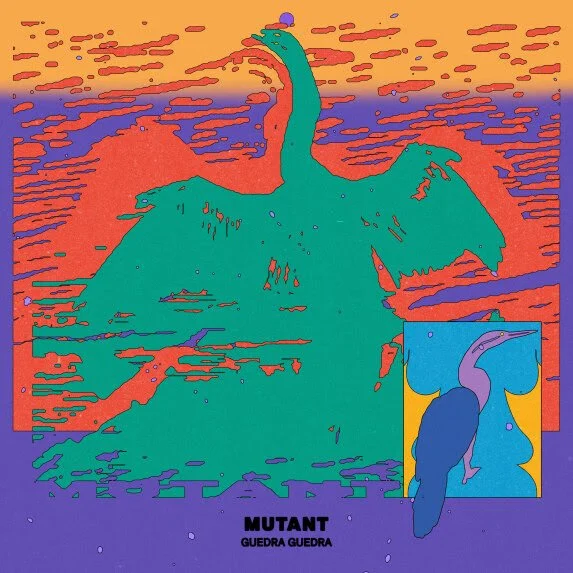
MUTANT artwork by Nassim Azarzar:
Tracklisting:
1. Drift of Drummer
2. Paradigm
3. Renegade
4. Calling Out
5. The Arc of Three Colours
6. Tribes With Flags
7. Ring of Fire
8. Four Lambs
9. Z
10. Tamayyurt
11. Enlightenment
MUTANT will be available on white vinyl with a limited edition screen-printed jacket, standard black vinyl, CD and digitally. Pre-order here: Dom Mart| Digital.
MORE ON GUEDRA GUEDRA:
The name Guedra Guedra refersto a Moroccan traditional dance from Saharan communities, and a type of cooking pot that can be adapted into a drum by stretching a leather skin over the top of it. Abdellah was born and raised in Casablanca, Morocco and today lives between that city and Marrakech. When he was growing up, he was a bassist and a drummer in various bands, playing everything from metal to reggae and rock. He started to get interested in electronic music and dub when he heard producers like Aisha Kandisha’s Jarring Effects, Muslimgauze and Badawi, all artists that fused parts of Moroccan traditional music with machine sounds.
Abdellah produced two releases under the name Dubosmium, an electronic dub project, and started a parallel practice as a sound artist, using samples and field recordings he’d made while travelling around Morocco, Egypt, Mauritania, Senegal and other African countries. “I would record storytelling from different people to think about collective memory. It’s a way to reflect together on our history and identity, and to bring forth a shared knowledge that is not imposed from above, but built with those who live it,” he says. “From my archive, I then tried to create some sound pieces, installations and visuals.” Abdellah went on to reconfigure his sound as Guedra Guedra, aiming to preserve African musical practices by mixing parts of his field recordings with cutting-edge beats. “I met a lot of people around the world who’d say, ‘We need to save this traditional music practice, you should bring people to the studio to record.’ But I don’t feel that you can just bring a musician in from the mountains into a modern studio and capture their sound authentically, so I focused on field recordings and thought that this approach could form the foundation of my electronic music.”
On his Son of Sun EP (2020) and debut album Vexillology(2021), released via On The Corner Records, Guedra Guedra used bass-heavy rhythms from dubstep, footwork and hip-hop, adding sampled voices, percussion and instruments with environmental found sounds like bird song and crashing ocean surf. Vexillology went on to receive glowing praise fromMixmag, The Guardian and Resident Advisor.
Building on the innovations of these records, MUTANT finds Guedra Guedra committing to incorporating a growing array of Pan-African polyrhythms into the dancefloor. His music serves as a form of resistance and a process of decolonization, a call to imagine spaces that passionately embrace marginalized voices and African presence, and to question power dynamics within the realms of art. “This reappropriation of spaces for musical creation and celebration is of utmost importance in Afrofuturism,” says Abdellah. “It overturns power relations and valorizes cultures and ancestral knowledge, while placing the issues of memory, ownership, and access at the heart of the decolonial debate.”
In the process of developing and sculpting his sound, Guedra Guedra is exploring his identity as an artist in Morocco, a country with a complex history that incorporates aspects of the MENA (Middle East and North Africa) area and other parts of the African continent into its cultural heritage. “Some people in Morocco will say, ‘we are Arab’; the other one will say, ‘no, we are Amazigh.’ I talk about myself as a Moroccan,” says Abdellah. “We are in the context of the Arab world, but at the same time we are in the context of Africa, which was also colonized by French people.” Abdellah sees Guedra Guedra as a project of technological as well as cultural decolonization. “Mainstream music production software has often carried biases, reflecting the cultural dominance of the West and excluding non-western configurations of sounds and beats,” he says. “By utilizing machines and orienting them towards polyrhythmic Sub-Saharan and North Africa, MUTANT contributes to a more inclusive and representative technological dimension of bass music production.”
MUTANT is a revolutionary record, an ingenious meld of the organic and the electronic. While Guedra Guedra’s samples and field recordings celebrate the diverse folk music history and heritage of Africa, his drum programming and synth work across the album reinterpret these sounds for dance floors. As Abdellah says, he’s “researching rhythm, researching sound, researching people. I said, ‘I need to learn more about African culture.’ I’m learning at the same time as I’m doing this music.”
GUEDRA GUEDRA LIVE
May 24 -Portugal - Mertola Islamic Festival
July 4 - Netherlands - Down The Rabbit Hole Festival
July 26 - Spain - secret show (Vigo)
Guedra Guedra Online:
Instagram | Spotify | Apple Music
Smugglers Way
Website | Instagram